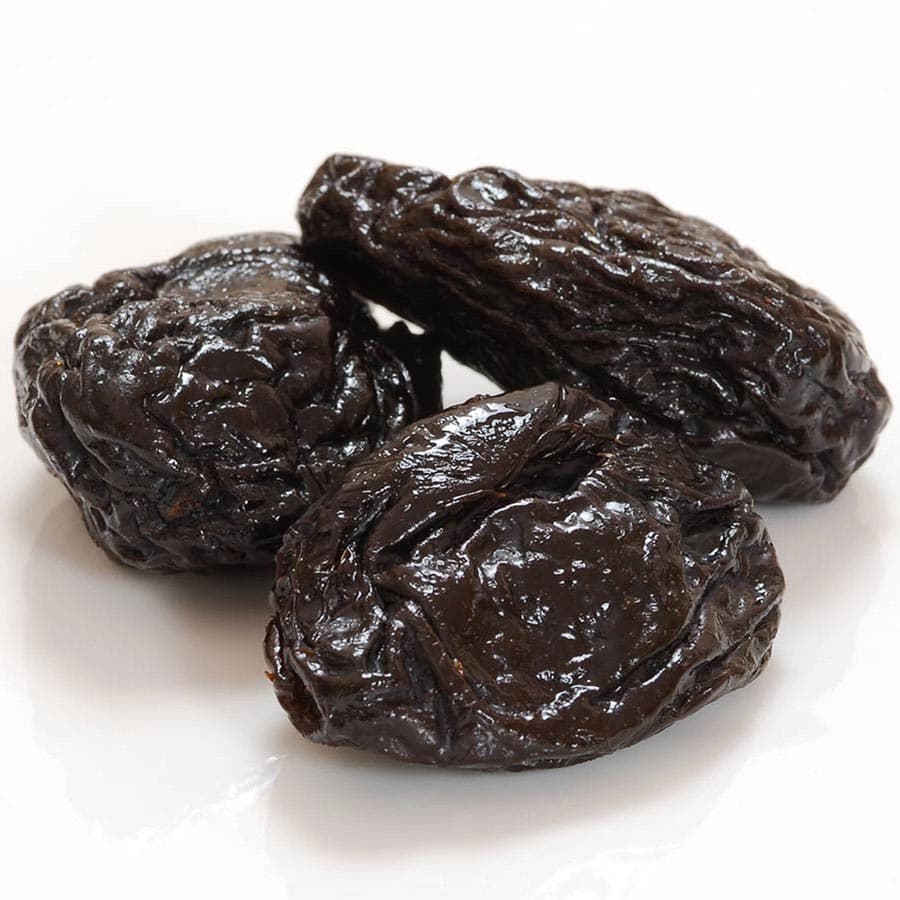
Prune Extract is a water-soluble fruit concentrate derived from Prunus domestica and standardized to a minimum 60°Brix without supplementary sucrose or glucose addition, functioning as a self-preserving liquid ingredient for food, beverage, confectionery, and health-product manufacturing.
Active Compound Profile
The functional identity of Prune Extract is defined by its native soluble solids matrix recovered from prune pulp during aqueous extraction and concentration. The material is produced as a pure natural water-soluble extract in which the predominant constituents are fruit-derived sugars — principally fructose and glucose — alongside soluble dietary fiber fractions, organic acids such as malic and citric, and a minor phenolic load contributed by neochlorogenic and chlorogenic acids native to the prune tissue. The absence of added sugar distinguishes the concentrate from reformulated syrups, as the entire soluble solid fraction originates from the fruit itself. With a very low fat content under 0.1%, the extract presents a near-fat-free aqueous system in which hydrophilic compounds dominate the physical and microbial stability behavior.
For formulators in the food and beverage sectors, the coordinated sugar-acid-phenolic ensemble is the primary procurement driver because it supplies both sweetness and mild preservative character without extraneous lipid oxidation risk. Confectionery manufacturers evaluate the same fraction as a binding and plasticizing agent where low fat minimizes rancidity during extended shelf residence, whereas health-product producers prioritize the native soluble fiber and phenolic content as label-friendly functional components. Retention of the complete fruit matrix distinguishes the material from isolated sugar syrups or reconstituted dried prune powders, which sacrifice the balanced acid and micronutrient profile during fractionated processing.
Specification and Physical Parameters
The commercial specification of Prune Extract is anchored by its concentration to at least 60°Brix, a refractometric measurement confirming the minimum soluble solids load per hundred grams of product. This Brix threshold is achieved without added sugar, meaning the refractive index is generated entirely by fruit-native carbohydrates and accompanying solubles. The product further conforms to a pH range of 3.5 to 4.0, placing it within a mildly acidic band that suppresses proliferation of spoilage microorganisms. Fat content is maintained under 0.1%, confirming the extract as a virtually lipid-free system. The convergence of high soluble solids and low pH yields a viscous liquid phase that is intrinsically self-preserving and exempt from refrigerated storage requirements under ambient conditions.
- Minimum Brix: 60° (refractometric, no added sugar)
- pH interval: 3.5 – 4.0
- Fat content: < 0.1% by weight
- Storage class: ambient, non-refrigerated, self-preserving
- Physical state: viscous water-soluble concentrate
Extraction Methodology
The production of Prune Extract is oriented toward maximal recovery of the fruit's soluble solids through aqueous extraction of prune tissue followed by concentration. The starting substrate is contacted with water to mobilize sugars, organic acids, soluble fiber, and phenolics from the pulp matrix. The resulting liquor is then concentrated by evaporation to reach the specified minimum 60°Brix, a step that removes free water without introducing external sweeteners. Because the process is purely water-based and relies on physical concentration rather than solvent extraction or fat incorporation, the finished extract retains the under-0.1% fat characteristic and the natural acid balance of the source fruit. No refrigeration-dependent intermediates are required, as the concentration itself establishes the preservative Brix and pH envelope.
At 60°Brix and pH 3.5–4, prune extract is a self-preserving water-soluble concentrate with under 0.1% fat
Self-Preserving Mechanism
The self-preserving status of Prune Extract is a direct consequence of its specification rather than of added antimicrobial agents. At or above 60°Brix, the water activity of the system is reduced to a level that restricts metabolic activity of yeasts, molds, and many bacteria. The accompanying pH of 3.5 to 4.0 reinforces this barrier by maintaining an environment outside the neutral range preferred by spoilage flora. The negligible fat content under 0.1% removes a common substrate for oxidative degradation, further extending ambient stability. Together, these parameters yield a viscous concentrate that does not require cold-chain logistics, a relevant factor for bulk ingredient procurement and warehouse planning in the food, beverage, confectionery, and health-product industries.
Industrial Application Scope
Prune Extract is specified for use across four principal manufacturing domains, each leveraging a distinct facet of the concentrate's physical and compositional profile.
- Food Industry: employed as a natural sweetening and humectant base in baked and prepared goods where ambient-stable liquid solids are required.
- Beverages: incorporated as a fruit-solid enhancer and mild acidulator in still and functional drinks, capitalizing on the 3.5–4.0 pH and native sugar load.
- Confectionery: applied as a plasticizing binder in chews and bars, with the sub-0.1% fat parameter reducing rancidity exposure during shelf life.
- Health Products: utilized for its label-friendly soluble fiber and phenolic fraction delivered through a pure water-soluble, no-added-sugar matrix.
Full technical documentation and procurement parameters are available on the product specification page for formulators requiring batch-level certification.
Formulation Considerations
When integrating Prune Extract into industrial formulations, manufacturers should account for its contributory Brix and acidity as part of the total recipe balance. At a minimum 60°Brix and pH 3.5–4.0, the extract delivers measurable soluble solids and hydrogen-ion load that may reduce the need for external acidifiers or sugar syrups in the finished system. Its viscous nature requires controlled dosing equipment capable of handling high-refractive-index liquids, and its water-soluble character permits direct dispersion in aqueous phases without pre-emulsification. The under-0.1% fat content ensures compatibility with low-lipid matrices where oxidative stability is a controlled variable. Across food, beverage, confectionery, and health-product lines, the extract's self-preserving specification supports simplified labeling and reduced cold-chain dependency relative to perishable fruit intermediates.
Frequently Asked Questions
What is the minimum Brix level of prune extract concentrate?
The prune extract concentrate is concentrated to at least 60°Brix with no added sugar.
What is the pH range of prune extract concentrate?
The pH of the extract ranges between 3.5 and 4, contributing to its self-preserving properties.
What is the fat content specification for prune extract?
Prune extract concentrate has a very low fat content of under 0.1% by specification.
Does prune extract require refrigerated storage?
No. Due to its viscosity, Brix level, and pH, it is self-preserving and does not require refrigerated storage.